!—continous>
Showing posts with label Ethan Hawke. Show all posts
Tuesday, February 19, 2013
Friday, February 15, 2013
Photo: Vincent D'Onofrio and Ethan Hawke in 'Clive'...
Saturday, February 9, 2013
Friday, February 8, 2013
'Theater Reviews: Ethan Hawke’s Clive'
VULTURE
By Scott Brown
By Scott Brown
Clive
I feel like Ethan Hawke and I have grown old together. His latest directorial effort, Clive, is brief yet interrrrrrminable, and our lives together flashed before my eyes. (Slowly. Excruciatingly!) We were Explorers together, we bit reality just a few years apart, and we will always, always have Paris, and Julie Delpy. (Well: He will.) Hawke was X, I was Y; he was a whole lot prettier and, I can safely assume, had a whole lot more fun, his mirror-practiced mope-face aside. And to paraphrase another nineties totem The Crying Game — we're certainly not a young thing anymore.
You know who is a young thing? And always will be? Bertolt Brecht's Baal, the quasi-anti-romantic hero of his first play, Baal. He's all cruelty and animal vitality — a user and discarder of women and men (but especially women), a predator, a scavenger, and, naturally, an artist, though not a particularly great one. (The best, most endearing aspect of Baal is what a square and lame-o poet he is.) Brecht was a college student when he created the character and seems to have had no thunderous opinion on what Baal meant as an archetype or as a man. He was interested in what he was, his phenomenology, how a Baal functioned in a fallen world. Later, Brecht would call Baal a "relative man," a "passive genius" deft at "exploiting the exploiters," who is "antisocial, but in an antisocial society." All of this sounds a lot like late-breaking revisionism to me. (Brecht also wrote, "I admit (and advise you): This play is lacking in wisdom.") There were a lot of fascists running around, hijacking Expressionism, claiming the postromantic hero as their own, and this play was a molotov lobbed through the window of that particularly villainous frat house. Like Baal, Brecht was just having a good time being bad, in anticipation of very bad times to come.
The problem with Clive — "based on, inspired by, stolen from Brecht's Baal" — is that it's not having a very good time at all. It lacks relish, which would seem to be a key ingredient in any story about the ruthless pursuit of pleasure. Clive is directed by Hawke, who also stars as the title character, a would-be rock idol with Billy Idolatrous hair and eye shadow. It’s set in the kinda-nineties, and there are cheeky nods to Reality Bites, especially in Clive's plunky three-chord songs. At times, the whole thing seems to be a joke on the Hawke persona — or maybe just a joke, period. (In his author's note, playwright/adaptor Jonathan Marc Sherman writes, "I worked from a literal translation courtesy of Google Translate. I do not recommend that you try this." And how!)
But the jest, alas, savours but of shallow wit, when hundreds sleep more than do laugh at it. (Wow, Clive apparently brings out the intellectually defensive English major in all of us!) The opening is highly promising: A grim if not really sincere benediction on the nature of evil from Doc (twitch-monster-from-another-dimension Vincent D'Onofrio, who doffs his hairpiece and puts on a cornpone drawl). This is followed by a strummed hymn croaked by Clive himself. Everyone's hopping around Derek McClane's abstract-yet-lived-in set, with its doors to nowhere and hidden musical instruments built into every cranny. It's a world absotively wet with possibility, a world just waiting to be diddled and despoiled. Now what?
Now … not much. Clive proceeds systematically to sabotage his ascent as a rock star, throw offal in the faces of the powerful, and go through women like the Goodwill rummage bin. He has two idée fixes: a teenage girl (Zoe Kazan, who has a gift for indecency I wish this production would allow her to explore even further) and an ursine hill-spirit of a grown man (D'Onofrio). Both are innocents, both are Clive (or facets of Clive), and our bad boy, caught between them, eventually destroys both in defense of his sacred independence. Hawke's performance falls into an uncanny valley: He's too close to Clive to have perspective, but too different — and, frankly, a bit too old — to merge with the feral fun. He falls back on the throaty, craggy slackerdom we know so well, and misses opportunities to guide and focus the show's energies as a director, perhaps because he's too busy with actor business. (Hawke's an excellent director — his Lie of the Mind proved that, but it's a tall order to direct and act when you are the play.) Clive feels more like a busy little bureaucratic tangle of inside jokes and outsize personalities than a fully fleshed production. Instead of pulsating with forbidden, demonic energy, it just kind of sits there chuckling bitterly, the gnomic drunk in the corner instead of the life of the party. Well, balls.
Clive is playing at Theatre Row through March 9.
Tuesday, February 5, 2013
'Clive' Review by Ted Cornwell
One of the great pleasures of living in NYC is getting to see some of the biggest names in film and television performing on stage from time to time. I’m particularly impressed by the commitment of people such as Ethan Hawke to promoting new and interesting live theater via companies like The New Group. Last weekend, I had the chance to see Hawke (along with Vincent D’Onofrio, and Joe Kazan, et.al.) in a contemporary adaptation of Bertolt Brecht’s play Baal, retitled Clive. The protaganist has been transported to 1990s New York, where “Clive,” the title character, is a rock star who’s circling the drain in every sense -- emotionally, morally, and physically. The play is unrelentingly intense and bleak, but also compelling and intoxicating. And Hawke’s fiery performance is something to behold. Where anyone gets the stamina to take on a performance like that is a mystery to me. The show features some live music and inventive staging. But it’s the performances, not just from Hawke but from the rest of the cast as well, that really make it a major event to see. The new script is by Jonathan Marc Sherman, and not being familiar with the original I can’t know how faithful it is to Brecht. But it’s a show that never leaves you losing interest. I left feeling chilled by the long, cold decline of the title character. P.S. I sat in the front row, along side my friends Michael and James. I don’t think I’ve ever been slow close to the stage that I could see every vein and line in the character’s faces before. P.S. Since I haven't been here for a while, I'll add a few notes about recent reading. I finally introduced myself to the work of A.M. Homes, who I heard read at the Cornelia Street Cafe a few weeks back. Her novel, Music for Torching, read like a fusion of Richard Yates and Paul Auster – in a good way. It was dreamlike and provocative throughout, following a suburban marriage that seems to be coming apart at the seems. And recently I've picked up Fay Weldon's Rhode Island Blues, which is reminding me why I've always loved her wit and insight. Thank god she's so prolific, it seems I'll always be able to find something by Weldon that I haven't read before.
Posted by Ted Cornwell at 1:44 PM
Tuesday, January 29, 2013
'Jonathan Marc Sherman on the Inspiration For Clive & His 20-Year Collaboration With Ethan Hawke'
BY JONATHAN MARC SHERMAN
BROADWAY.COM

BROADWAY.COM
Jonathan Marc Sherman
This is the third play of mine that Ethan has acted in, and the third play of mine he's directed, but it's the first time he has worn both of those hats together.
About the author:
Playwright Jonathan Marc Sherman first teamed up with his friend Ethan Hawke in 1991 to create New York City's innovative Malaparte Theater Company. Hawke and Sherman became artistic collaborators—Hawke starred in Sherman’s short play Sons and Fathers, then directed his full-length dramedyVeins and Thumbtacks. After reuniting on Sherman’s well-received Things We Want in 2007, the duo has returned to off-Broadway's New Group to debutClive—a play (with music) written by Sherman, directed by Hawke, and starring them both, together with Vincent D'Onofrio and Zoe Kazan. Below, Sherman shares his inspiration for the new project, and how his latest collaboration with Hawke is like "doing it without a net."

It started because Sir Tom Stoppard saw Ethan Hawke play Autolycus in The Winter's Tale in 2009, and mentioned to him that he should play the title role in Brecht's Baal. Ethan asked me if I had read the play. I said I might have read it while stoned at college.
Ethan thought adapting the play might give me a chance to write about a darker period in my life. I've been clean and sober for 11 years, eight months, and counting. I titled the play Clive to free myself up, and because I like the sound of the word, and because I got my Equity card at age 14 when I played The Artful Dodger inOliver! in the summer of 1983 in Pittsburgh, and Fagin was played by Clive Revill. There was another, more personal reason, for my choice. Before I cleaned up my act, I had a name for my wasted persona, and that name was Clive. It came into existence after a friend of mine, whose boozy nickname was “Grabby the Clown,” turned to me one night and pointed out that I got loaded just as much (indeed, far more) than he did, yet I had no boozy nickname. So I became “Clive.”
Brecht wrote the first version of Baal, when he was 20 years old and still a college student, in response to the play Der Einsame by Hanns Johst, which glorified the life of 19th century German playwright Christian Dietrich Grabbe. Clive is less concerned with the glorification of 19th century German playwrights or poets, and more concerned with the glorification of 20th and 21st century artists, particularly those who become more legendary in death than they were in life.
When I turned 20, I was in the first term of my junior year at Bennington College and the first production of my first full-length play [Women and Wallace] had just closed two days earlier in Playwrights Horizons' old pre-renovation building (a former strip club) on 42nd Street between Ninth Avenue and Dyer Avenue. It's a quarter of a century since then, and now I'm in previews with a play on the same side of the same street on the same block.
There's a beautiful library at Bennington, but I don't remember reading Baal there. I do remember reading Wallace Shawn's terrifying play Aunt Dan and Lemon there, and also one of the wonderful accompanying essays in particular, "Notes in Justification of Putting the Audience Through a Difficult Evening", which has been on my mind lately. It ends with this line:
“What's important, of course, from the world's point of view, is not what's in our heads, but that our behavior should change—our behavior and the attitudes which underlie it—but how can we start to change our attitudes or our behavior if we haven't first thought about why we must change and in what direction?”
A couple of other quotes gave me guidance during the writing ofClive. One was from Stoppard, whose comment to Ethan began this whole experiment in the first place. In his Paris Review interview, he says about adaptations that "you're not doing an author a favor if the adaptation is not vibrant.” Another quote was Brecht's himself, via Eric Bentley: “Anyone can be creative, it's rewriting other people that's a challenge.” I certainly found it challenging, and for that reason all the more thrilling.
I tried to find one example of a way people mistreated each other in the original play that had been eradicated in the intervening decades, and told myself that if I could, I was off the hook and free to write something else (perhaps a light comedy). People are, alas, still abusing substances and other people in all the same old ways, it seems, and in some new and awful ways as well. So here I find myself, putting the audience through a bit of a difficult evening.
This is the third play of mine that Ethan has acted in, and the third play of mine he's directed, but it's the first time he has worn both of those hats together. We've acted together in four plays before, as well, but I only wrote one of those. Having the director onstage and the writer onstage was part of the point, to do it “without a net,” which has made the process of working on the play unique and exciting and dangerous for the whole company (and hopefully, now, for the audience). So if you're on the block and in the mood, I invite you to come check out our experiment.
Playwright Jonathan Marc Sherman first teamed up with his friend Ethan Hawke in 1991 to create New York City's innovative Malaparte Theater Company. Hawke and Sherman became artistic collaborators—Hawke starred in Sherman’s short play Sons and Fathers, then directed his full-length dramedyVeins and Thumbtacks. After reuniting on Sherman’s well-received Things We Want in 2007, the duo has returned to off-Broadway's New Group to debutClive—a play (with music) written by Sherman, directed by Hawke, and starring them both, together with Vincent D'Onofrio and Zoe Kazan. Below, Sherman shares his inspiration for the new project, and how his latest collaboration with Hawke is like "doing it without a net."
It started because Sir Tom Stoppard saw Ethan Hawke play Autolycus in The Winter's Tale in 2009, and mentioned to him that he should play the title role in Brecht's Baal. Ethan asked me if I had read the play. I said I might have read it while stoned at college.
Ethan thought adapting the play might give me a chance to write about a darker period in my life. I've been clean and sober for 11 years, eight months, and counting. I titled the play Clive to free myself up, and because I like the sound of the word, and because I got my Equity card at age 14 when I played The Artful Dodger inOliver! in the summer of 1983 in Pittsburgh, and Fagin was played by Clive Revill. There was another, more personal reason, for my choice. Before I cleaned up my act, I had a name for my wasted persona, and that name was Clive. It came into existence after a friend of mine, whose boozy nickname was “Grabby the Clown,” turned to me one night and pointed out that I got loaded just as much (indeed, far more) than he did, yet I had no boozy nickname. So I became “Clive.”
Brecht wrote the first version of Baal, when he was 20 years old and still a college student, in response to the play Der Einsame by Hanns Johst, which glorified the life of 19th century German playwright Christian Dietrich Grabbe. Clive is less concerned with the glorification of 19th century German playwrights or poets, and more concerned with the glorification of 20th and 21st century artists, particularly those who become more legendary in death than they were in life.
When I turned 20, I was in the first term of my junior year at Bennington College and the first production of my first full-length play [Women and Wallace] had just closed two days earlier in Playwrights Horizons' old pre-renovation building (a former strip club) on 42nd Street between Ninth Avenue and Dyer Avenue. It's a quarter of a century since then, and now I'm in previews with a play on the same side of the same street on the same block.
There's a beautiful library at Bennington, but I don't remember reading Baal there. I do remember reading Wallace Shawn's terrifying play Aunt Dan and Lemon there, and also one of the wonderful accompanying essays in particular, "Notes in Justification of Putting the Audience Through a Difficult Evening", which has been on my mind lately. It ends with this line:
“What's important, of course, from the world's point of view, is not what's in our heads, but that our behavior should change—our behavior and the attitudes which underlie it—but how can we start to change our attitudes or our behavior if we haven't first thought about why we must change and in what direction?”
A couple of other quotes gave me guidance during the writing ofClive. One was from Stoppard, whose comment to Ethan began this whole experiment in the first place. In his Paris Review interview, he says about adaptations that "you're not doing an author a favor if the adaptation is not vibrant.” Another quote was Brecht's himself, via Eric Bentley: “Anyone can be creative, it's rewriting other people that's a challenge.” I certainly found it challenging, and for that reason all the more thrilling.
I tried to find one example of a way people mistreated each other in the original play that had been eradicated in the intervening decades, and told myself that if I could, I was off the hook and free to write something else (perhaps a light comedy). People are, alas, still abusing substances and other people in all the same old ways, it seems, and in some new and awful ways as well. So here I find myself, putting the audience through a bit of a difficult evening.
This is the third play of mine that Ethan has acted in, and the third play of mine he's directed, but it's the first time he has worn both of those hats together. We've acted together in four plays before, as well, but I only wrote one of those. Having the director onstage and the writer onstage was part of the point, to do it “without a net,” which has made the process of working on the play unique and exciting and dangerous for the whole company (and hopefully, now, for the audience). So if you're on the block and in the mood, I invite you to come check out our experiment.
Tuesday, January 22, 2013
'Clive' Review by Blanca Acevedo
Clive-First Saturday Matinee 1-19-2013
Photo by Blanca Acevedo Be warned-this review contains some major spoilers!
Photo by Blanca Acevedo I saw the first matinee of Clive today at the Acorn Theater on West 42nd Street, just blocks from Times Square. In this fast-moving and most unusual play, Vincent dominates the stage, overshadowing the other actors, including Ethan Hawke, who plays the lead role of Clive. The play begins with Vincent's character, Doc, appearing from behind a red door, centerstage, then reaching from behind the door to tap out notes on a xylophone built into the door as he announces "Satan is real." All the seven doors onstage were designed as unique sound sculptures by Gaines with musical instruments and song lyrics built into the design. These scuptures will produce sounds unique to each performance of Clive, thereby creating an original musical score each night. The guitars used by Clive and Doc and the piano onstage all have various lines written on the surfaces. The set is beautifully designed with walls made of silvery beer cases with brand names like Durst and beer cans framed by a curtain made of the tops of beer cans. It's quite a feast for the eyes!
Lobby of the Acorn Theater-photo by Blanca Acevedo Ethan soon appears and announces the beginning of the play, and also reveals that he will play the role of Clive because "I'm dead." Indeed, we are led through various outrageous and sometimes tawdry vignettes in the life of Clive and his buddies, bimbos and best friend Doc, leading up to Clive's tragic end in a rather strange circumstance. Let's just say it involves ice fishing. "A rat lies in the gutter dying...so what?" Ethan brings the rock star swagger to his role of Clive, brandishing his guitar for several musical numbers and even reciting lines written on the guitar, admonishing Joanne, his friend's teenaged girlfriend, to "clean up and go home" after a night of debauchery, punctuating his insult with the boast "I fucked you well." In the first of several tragedies that haunt Clive, Joanne drowns herself after losing her virginity to him and suffering his rejection. But Clive just can't help himself, and soon impregnates and abandons Sophia, who's adored by a devoted Doc, but loves Clive.
Photo by Blanca Acevedo Doc is a striking figure onstage, dressed in country western garb and howling at the audience at times, even barking like a bulldog at Clive's behest, but Doc is no court jester. Vincent brings his own larger than life swagger to the role of Doc, who's boisterous and charming with a pronounced southern drawl and thirst for booze, babes and blow to match his towering frame. Doc and Clive share an unexpectedly homoerotic moment as both are seated on the stage and Clive jumps onto Doc's lap. As they embrace, I could swear they were about to kiss, but they do not. Hot damn! Zoe Kazan, who was hilarious in "A Behanding in Spokane" with Christopher Walken, Anthony Mackie and Sam Rockwell in 2010, plays Joanne the blond, Sophia the brunette and the nameless redhead who falls for Doc, only to be ravished by Clive in the bushes after Doc's boast that she "fucked me like a squirrel fucks another squirrel." ??? Imagine how funny that line sounds when spoken by George Geronimo Gerkie, sans the wig and hat, and you'll get a sense of the strange humor that permeates Clive. Speaking of the little red-haired girl, she gets a few playful spanks on the butt from Doc, who's all hands with her in their brief time together onstage. Charlie Brown never had it so good! As for nudity, Doc's bald head and Clive's shirtless staggering about the stage will have to suffice. Sorry, Vixens.:(
Photo by Blanca Acevedo Aside from Vincent and Ethan, the rest of the cast play multiple roles throughout the 1 1/2 hour production, from pals of Clive to junkies, prostitutes to priests, and a group of fishermen who taunt a dying Clive while snorting drugs from his prone body. Music is performed by the actors in fragmented segments throughout the play, so I wouldn't call this a concert or musical. Vincent and Ethan perform a country-flavored duet with their twin guitars, but they chant the words rather than actually sing them. Clive also performs by a piano decorated with lines such as "First the man takes a drink, then the drink takes...." and "Mama tried." Shades of artist Jean-Michel Basquiat here and on the guitars, as well. Clive's guitar sports various lines of dialogue and the legend "Be Nice To Me Sweetheart This is My Room" and the name "Elephant." Doc's guitar is named "Elephant My Ass" and bears a legend around the body of his guitar similar to Clive's.
Photo by Blanca Acevedo Major Spoiler!!!! Don't read this if you don't want to know what happens to Doc near the end of the play. Otherwise, read on..... As we know by now, Vincent has played many villains and anti-heroes on screen and on TV, and they usually die onscreen. Well, sorry to say that Doc meets his end after a bitterly drunken fight with Clive, sparked by jealousy and resentment over past wrongs (remember Doc's redheaded girlfriend?) Doc, who once snorted dope with Clive off their guitars, explodes with rage, demanding to know "Are you the only girlfriend I'm allowed to have?" A barroom brawl turns deadly as Clive, switchblade in hand, turns Doc into a ghost bathed in red light. Doc later appears with angel's wings, one wing bearing the words "Doc is dead" and the other "RIP." Clive's downfall is a foregone conclusion-"A rat lies in the gutter dying...so what?" Sex, drugs, rock and roll, larceny, rape, murder, etc........Are people nothing but hedonistic animals? Is love even possible in such a godless world? Who cares? I think Doc would have, definitely.
THANK YOU, BLANCA! VISIT BLANCA'S SITE HERE
Thursday, January 10, 2013
Ethan Hawke...'In His Comfort Zone'
NEW YORK TIMES
By DAVID CARR
Published: January 10, 2013
SEEING Ethan Hawke perched on a folding chair in a grungy Midtown rehearsal space leading actors through a reading is a bit of a shock. Not that he is there: Mr. Hawke is a steady presence in the New York theater scene, and he is rehearsing “Clive,” a play about a ’90s-era New York rocker gone very, very bad, in which he stars and directs.
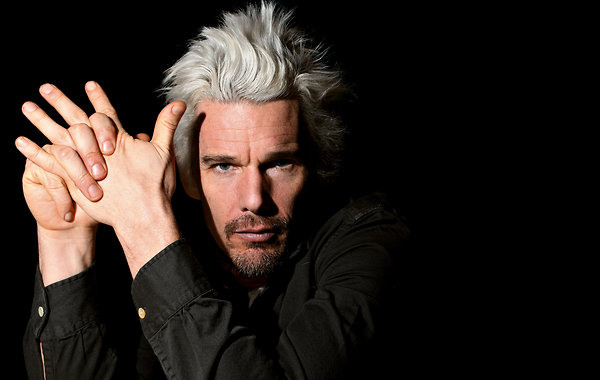
No, it’s his hair. Vertical and shot through with silver, with notes of green (or is that blue?), his mane looks like a prop, which in a way, it is. “I don’t know how to explain it exactly,” he said, pointing at his head. “I didn’t want to feel like me when I did this role.” He added: “I’m trying to do that old-school, third-person thing by unlocking something as utterly superficial as my hair. I was shooting for a Bowie thing, but then I saw a picture of him after I did it, and he didn’t really do his hair like this.”
It’s a goofy gambit to serious ends, a very physical expression of his desire to do something remarkable. And like much else taken on by Mr. Hawke, a former movie heartthrob and Gen X hood ornament who is now a 42-year-old father of four, it would seem pretentious if it weren’t done in dead earnest.
“Clive” is an adaptation of Bertolt Brecht’s “Baal” written by Mr. Hawke’s longtime friend Jonathan Marc Sherman. For Mr. Hawke the play is of a piece with a theater career that has included founding a scrappy company with like-minded buddies, directing new work as often as he can, and a gritty star turn in the revival of David Rabe’s“Hurlyburly,” which, like “Clive,” was produced by the New Group. That’s been mixed with high-minded work like Tom Stoppard’s “Coast of Utopia” trilogy, for which Mr. Hawke earned a Tony nomination, and the melancholy title character in Chekhov’s “Ivanov,” which he recently performed at Classic Stage Company.
“He attacked the life of that character, and like everything he does it is very much of the moment,” said Philip Seymour Hoffman, who starred with Mr. Hawke in Sidney Lumet’s movie “Before the Devil Knows You’re Dead.” By now that’s no surprise, he added: “Almost every single season he is doing something significant here in New York.”
It was Mr. Stoppard who accidentally got the ball rolling on “Clive.” He was taken by the intensity of Mr. Hawke’s performance in a small role in “The Winter’s Tale” and said he should think about performing “Baal,” Brecht’s early play about a murderously misspent youth. Mr. Hawke brought the idea to Mr. Sherman, who settled on a retelling through his own experience of addiction. “Clive,” which matches “Baal” character for character, scene for scene, begins performances Thursday at the Acorn Theater, with a cast that includes Vincent D’Onofrio, Zoe Kazan and Mr. Sherman himself.
Mr. Hawke will do everything but take tickets — act, direct, and sing his way through a scabrous portrait of a talented rocker and ferocious addict who is on his way to hell and leaves claw marks in everything around him as he goes. “He hurts people he loves,” Mr. Hawke explained. “But I think Brecht was thinking about something other than whether he’s good or bad, and I’m trying to get at those other things with the performance.”
Famous since he was 18 and certified Hollywood bankable after “Reality Bites” in 1994, he seemed to have enough cachet to live a relatively privileged professional life. And it’s not like he quit on mainstream film work. He received an Academy Award nomination in 2002 for his supporting role alongside Denzel Washington in “Training Day.”Lately, with money on his mind, he lined up two horror movies, “Sinister,” which did very well, and “The Purge,” which will be out in May.
Before that he will come full circle when “Before Midnight” has its premiere at theSundance Film Festival — the third film in Richard Linklater’s series in which Mr. Hawke stars with Julie Delpy in a meet-cute romance that, during the films, blossoms into a long-running dialogue about the nature of love and connection.
Given that he married and divorced Uma Thurman, going through the tabloid spanking machine in the process (he has since remarried), it’s not as if Mr. Hawke has completely lived the life of a monkish theater rat. But on balance the work that preoccupies him happens in rooms full of paper coffee cups, dog-eared scripts and long hours.
At the “Clive” rehearsal he is collaborative and encouraging, but clearly in charge and clear about what he wants. Before he leaves, he runs a debrief on the day’s work with everyone, slaps hands as he says it went “great,” and exits.
Walking down Ninth Avenue afterward, he may be the least put-together star you’ll ever see. One tail of the shirt is perpetually untucked; whatever he has on most likely emerged from a pile of similarly unremarkable garments.
He talks frankly about the magic coin of celebrity, the one that can be used to party like a rock star, mate with someone fabulous while picking and choosing among projects. He’s done all of those things, but at this point in his life directing an Off Broadway play in New York with like-minded actors seems like the highest and best use of his skills. As it turns out, Mr. Hawke, who in movies often played the reluctant pretty boy who was smarter than he was given credit for, has been playing to type all along.
“Early on when I experienced some success, I grew incredibly weary of what fame meant on a DNA level,” he explained. “My talent, whatever it was or is, was not strong enough to survive that. I had an allergy to being famous and have been neurotically chasing a larger dream, a substantive life in the arts, so that I didn’t end up getting defined by it.”
A great-grandnephew of Tennessee Williams, Mr. Hawke is a New York University English program dropout who has written two novels and is working on a third. He wants to be taken seriously but not come off as a jerk in the process. While some have found his always-on, go-for-broke approach wearying, he couldn’t care less.
“I’ve spent my whole life aping the theater work of others, learning on the way, but I feel like I’m stumbling on something that is original with this group of people,” he said of his “Clive” collaborators. “You haven’t seen a play like this before, and I don’t know exactly how it is going to work, but I do know it’s what I want to do with my life.”
Even early on in the rehearsals the complicated glories of the project are easy to spot. The music will emanate from seven doors onstage that have been converted to musical instruments, played by the actors. Cords and knobs seem stuck to everything, except the cast members, who play multiple roles. There are a lot of drugs, drink, bloody hookups and the kind of mayhem that puts shrapnel into all bystanders, including the audience.
At the center of it all is Clive, who sees fresh meat everywhere he looks.
Mr. Sherman, a former prodigy who wrote “Women and Wallace” at the age of 18, took a significant detour into mood-altering chemicals before rebounding with “Things We Want,” which Mr. Hawke directed in 2007. His take on Brecht is built on a Greek chorus of addicts. In one scene Clive is in a room full of them, one of whom lies dead from an overdose even as the rest continue to game their next high.
Surveying the corpse, Clive cuts to the chase: “He has his rest. We have our restlessness. Both are all right. After sleep we wake up. After sleep he doesn’t wake up. Both are all right.” There’s not a trace of empathy in his voice as he cadges the deceased’s bottle of whisky and his A.T.M. card.
While the stage will seem littered with shattered glass and broken humans, Mr. Sherman is very happy to be back in business with his antic, energetic friend. “I think that Ethan should leave his body to science,” he said. “He has a level of energy that I have not seen in people outside of those on major substances, and has this level of curiosity that just drives him. Live theater unlocks that.”
Part of why Mr. Hawke finds so much traction in the theater has to do with the nature of the transaction.
“When someone tells you they saw you in ‘Training Day,’ and that they liked what you did, it feels good, but I wasn’t there,” he said. “But if it is a piece of theater, I was part of it, and if someone, including other people I respect, comes to see some little play I did, that means a lot to me.”
Mr. D’Onofrio said the dual roles of acting and directing suit a mature Mr. Hawke. “Ethan has absolute confidence in what he is doing with ‘Clive’ and what he is doing with the rest of his career,” he said. “It’s about failing miserably and succeeding triumphantly, both.”
Mr. Hawke says that unlike Robert De Niro or his friend Mr. Hoffman, he cannot invent a character out of whole cloth. Every part he plays contains some component of who he is. Like Jesse, his character in “Before Midnight,” he has been divorced, is extremely emotional and dedicated when it comes to his children and is always wondering about the worth of work he chooses. How rare, then, that the young Ethan Hawke and the middle-age Ethan Hawke have been captured, like a time-lapse, in Mr. Linklater’s films.
“ ‘Before Sunrise’ was such an important movie for me because I learned to talk on screen,” Mr. Hawke explained. “Before that, all I had ever been asked was to brood for the camera. ‘Before Midnight,’ because of its sheer existence, ends up being about the passage of time. And yeah, your face falls apart and all that. But what I noticed is how much the same I am, how much of whatever I am is there in each film.”
True to form, Mr. Hawke retains his purchase on boyishness in the movie, but he does seem a little different more than 15 years later. Maybe because he knows who he is.
Thursday, January 3, 2013
Thursday, December 20, 2012
It's official! CLIVE rehearsals with Vincent D'Onofrio and cast have begun!
THE NEW GROUP BLOGSPOT
World Premiere
CLIVE
By Jonathan Marc Sherman
Directed by Ethan Hawke
with Brooks Ashmanskas, Vincent D'Onofrio, Ethan Hawke, Zoe Kazan, and more
Inspired by Bertolt Brecht's inflammatory play Baal, Clive tracks a dissipated songwriter in 1990s New York City from the hedonistic heights of seduction and consumption into an ecstasy of self-destruction. This production reunites Jonathan Marc Sherman and Ethan Hawke, who teamed previously at The New Group on Things We Want (written by Sherman, directed by Hawke). At once a celebration and a nightmare vision of life lived for pleasure, Clive boasts an eclectic selection of classic American songs performed live.
Set Design: Derek McLane
Costume Design: Cathy Zuber
Lighting Design: Jeff Croiter
Sound Design: Shane Rettig
Original Music: GAINES
Tuesday, November 13, 2012
Brooks Ashmanskas, Vincent D’Onofrio and Zoe Kazan Will Join Ethan Hawke in Off-Broadway's Clive
By Andrew Gans
13 Nov 2012
13 Nov 2012
Advertisement
Joining the previously announced Ethan Hawke in the title role will be Brooks Ashmanskas, Vincent D’Onofrio and Zoe Kazan. Additional casting will be announced.
Also directed by Hawke, the production will officially open Feb. 7 at 7 PM.
Inspired by Bertolt Brecht's inflammatory play Baal,Clive, according to press notes, "tracks a dissipated songwriter in 1990s New York City from the hedonistic heights of seduction and consumption into an ecstasy of self-destruction."
This production reunites playwright Sherman and director Hawke, who teamed previously at The New Group on Things We Want (written by Sherman, directed by Hawke, 2007 extended run).
Performances will be Monday, Tuesday and Wednesday at 7 PM and Thursday, Friday and Saturday at 8 PM with matinees Saturday at 2 PM.
Tickets, on sale in late November, may be arranged through www.telecharge.com or (212) 239-6200, or at the Theatre Row Box Office (12–8 PM daily). Tickets are $60 plus $1.25 restoration fee.
For more Information, visit www.thenewgroup.org.
Subscribe to:
Posts (Atom)